
2,650 Words / 11 min. Read
As the effects of climate change worsen, more people are wondering how it’s going to affect them personally. How is temperature and weather changing where you live? Is your home at risk from natural disasters, like wildfires and floods? And how will warming affect things like the economy, energy, health, and population trends?
We’ve done our best to answer all those questions with our free collection of climate risk maps; it’s a simple and powerful tool for evaluating your personal risk, seeing how conditions are changing, and finding out where threats and natural disasters are most common. With over 80 maps and counting, the only downside is that it’s a lot of information to take in.
So to help with that, we’ve gone through the whole collection to identify the 5 regions of America which are facing the most overall risk:
1. Central California
2. The Desert Southwest
3. South Central States
4. The Gulf Coast
5. The Southeast
This is a quick way to check whether you’re sitting in the line of fire, so you can take steps to mitigate (or avoid) those threats.
Regions vs. Locations
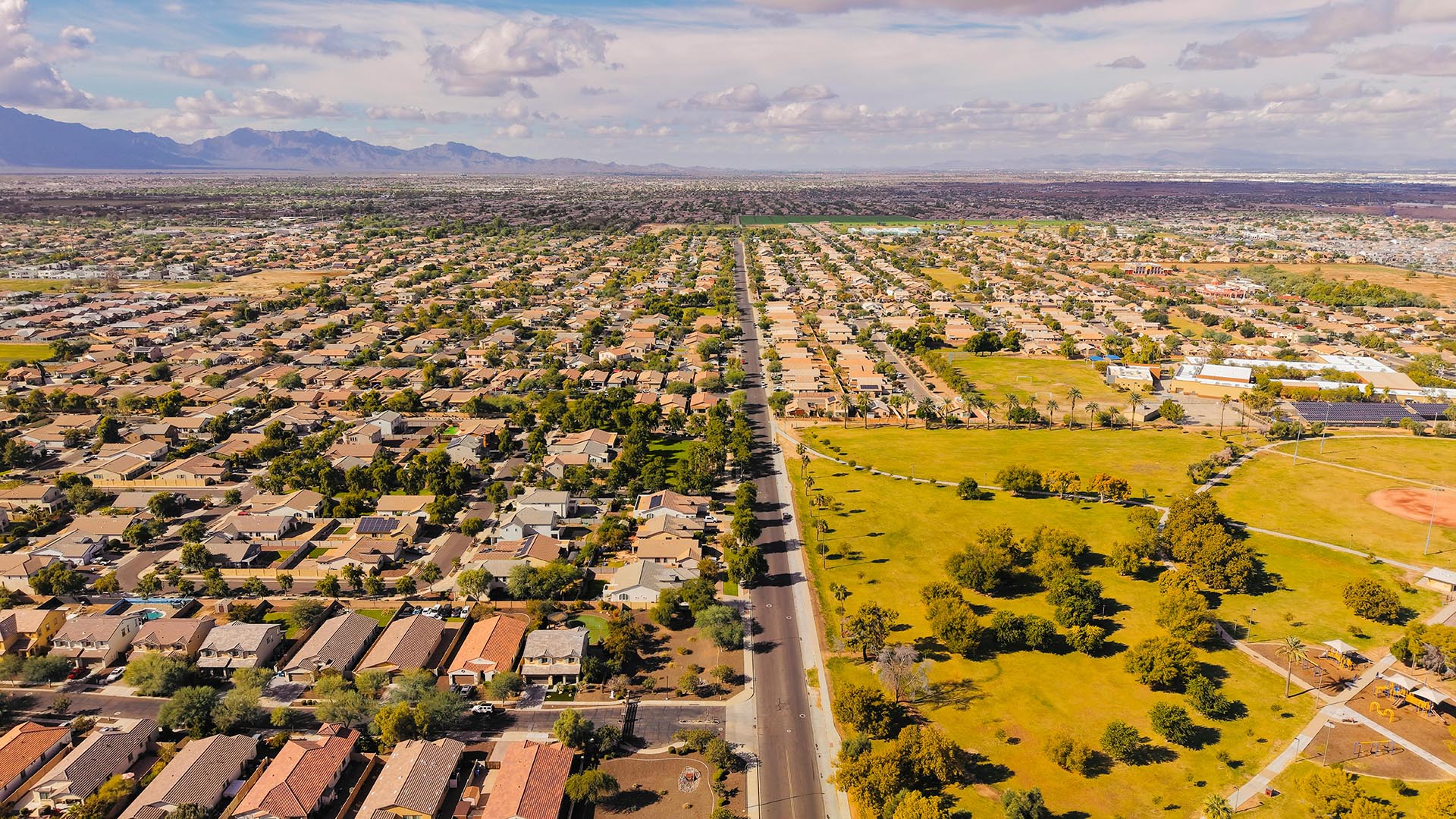
Before we dive in, let’s take a second to consider the difference between a geographic region and a specific location or property.
For example, you might live in a low-risk region, but on a high-risk property. Say you live by a riverbank in Vermont; the northeastern US is a decent spot from a climate perspective,1 but it’s known to get heavy rainfall and flooding.2 So while the region you live in might be considered resilient, your specific location might be at risk of being washed away.
Another scenario is a low-risk property within a high-risk region. Say you live in a fire-prone area of the western US, but you’ve removed fuel sources from the property and built a fire-resistant home. If a wildfire sweeps through the area, your house might be fine, but the surrounding landscape will be devastated, and essential services might have been severely impacted.3
Clearly, those are both scenarios we want to avoid. In this post we’re looking at regions of the country, but we would also recommend looking up your specific location. First Street and ClimateCheck both offer free address lookup tools for climate-fueled threats, so we’d recommend entering your location there to check your risk on a granular scale. (We also provide in-depth property risk reports for all our members.)

How to Read this Data
We’ve drawn on our full collection of risk maps to identify the most climate-vulnerable regions in the country. For each region we’ve identified primary risk factors (physical threats, like heat, fire, and floods), and secondary (socioeconomic) risk factors.
These factors link to their corresponding maps, so if you’re getting a login error, don’t worry; the maps are free! You can get instant access to them here.
In addition to the maps from our collection, we’ve compared our results to screening tools like CRSI,4 CVI,5 and STRESS,6 as well as disaster trackers from FEMA, NOAA and Climate Central.7 That led us to this list of regions which consistently ranked highest across multiple indices, confirming that they’re highly vulnerable to climate-related threats.
We’ve created mini-maps to highlight the states and counties within each region; you can view each counties’ risk factors (expressed as percentiles)8 by hovering your cursor over the map. This data is sourced primarily from the National Risk Index (NRI) and the 5th National Climate Assessment (NCA5). Note that these percentiles are calculated within the selected region; to see how a county or region compares on a national level, click on the links for their risk factors.
Ranking these regions by risk would be subjective, so instead we’ve listed them in geographic order from West to East. With that, let’s take a look at which regions of America are facing the most risk from climate change.
1. Central California
Primary Risk Factors: Heat, Drought, Wildfires
Exacerbating Factors: Community Resilience, Insurance Premiums, Insurance Nonrenewals
California - specifically the Central Valley - is facing a combination of extreme heat and drought which makes it highly susceptible to wildfires. Disaster risk is elevated by high population density and housing prices in the region.9,10 This in turn has led to a property insurance crisis, with premiums and nonrenewals soaring and several companies choosing to exit the state altogether.11,12
Out of all US states, California has experienced the most wildfires and the most acres burned since 1980, and has by far the most houses and properties exposed to risk.13 The 2025 Eaton and Palisade fires were the costliest fires in global history, with over $40 billion in insured losses.14 While regulations are slowly improving, combustible vegetation, high winds, and fire-prone buildings and zoning mean that California will likely experience more urban firestorms in the future.15,16
Coastal counties offer some refuge from the heat and flames, particularly those farther north (as indicated by the map). If you live in Central California and don’t want to relocate to a different state, you may be able to find respite along the 101. But even there you’ll likely find yourself inundated with wildfire smoke, which comes with a host of severe health effects.17,18
The demands of California’s population have stretched its resources thin,19 and urban development is often at odds with effective mitigation strategies.20 Without deep adaptation, most California residents are sitting in harm’s way.
2. The Desert Southwest
Primary Risk Factors: Heat, Drought, Wildfires, Floods
Exacerbating Factors: Social Vulnerability, Community Resilience
The desert Southwest - New Mexico, Arizona, and West Texas - is less at risk from wildfires than California, but faces a greater threat from extreme heat, especially in southernmost counties. Under 2 °C of warming (likely by mid-century), several counties in this region may experience more than 120 days per year with temperatures over 95 °F.21
Extreme heat is the deadliest weather hazard in America,22 and that risk will only increase as the world warms.23 Heat waves also put strain on power grids, as demand surges and efficiency drops.24,25 With passive solar construction or off-grid power, you may be able to achieve a level of resilience in this region, particularly farther north. But for the average person reliant on air conditioning and municipal power, extreme heat in combination with grid failure is an ever-present threat.
Dwindling water supplies also pose a threat to this area. Water is essential to life, hygiene, agriculture, and industry, and the Southwest is running dry. Arizona receives 26% of its water from the Colorado River,26 whose flow has dropped over 20% since 2000.27 A Bureau of Reclamation report found that there is not enough water to meet current demands across the basin, let alone support future demand increases.28
Groundwater - which accounts for 40% of supply - has also been rapidly declining.29 In the Phoenix area, development projects have been halted due to lack of water supply.30 Paradoxically, flooding is also a threat in this region. When rain does come, it falls fast and hard, overwhelming soil absorption and often turning to flash floods.31
Is it possible to build resilience in the desert Southwest? We think so; with permaculture, water harvesting, sustainable construction, and diligent site selection, one could mitigate many of the threats in this region. But for those living fossil-fueled lives in urban and suburban areas, time is running out.
3. South Central States
Primary Risk Factors: Heat, Humidity, Drought, Wildfires, Storms
Exacerbating Factors: Health, Infrastructure, Social Vulnerability, Community Resilience, Insurance Premiums, Insurance Nonrenewals
The South Central States of Arkansas and Oklahoma are facing a variety of overlapping threats. Like Kansas and Nebraska, they’re facing a high risk from hail, wind, and tornadoes; like Missouri, they’re facing a threat from wet bulb temperatures; like Texas, they’re facing a significant risk of drought and wildfires. But it’s all of these factors together - in combination with the extreme heat present at lower latitudes - that makes these 2 states especially vulnerable to climate change.
Oklahoma and Arkansas have experienced 50 federal disaster declarations since 2011,32 and have weathered nearly 160 billion-dollar disasters since 1980.33 While tornados pose a significant threat to human life, hail causes more frequent property damage, and has led to soaring insurance premiums in this region.34 In Oklahoma, rates rose nearly 40% from 2020 to 2023.35
While we tend to think of the mountain West as more fire-prone, Oklahoma is in the 84th percentile for fire risk in the nation.36 In 2025, over 170,000 acres were lost to wildfires in a historic storm event.37 While Arkansas has a lower fire risk, it averages around 1,000 wildfires per year,38 and lost over 20,000 acres to forest fires in 2025.39 Both states are facing a high risk from heat waves,40 which can make for a lethal combination when paired with the high humidity prevalent in the region.41,42
The diversity of these threats is what makes them so hard to prepare for. In regions facing one or two main threats, we can put together plans and take steps to mitigate them on our property. But with such a wide risk profile, that task becomes more daunting.
4. The Gulf Coast
Primary Risk Factors: Heat, Humidity, Floods, Hurricanes
Exacerbating Factors: Health, Community Resilience, Insurance Premiums, Insurance Nonrenewals
The Gulf Coast - Texas, Louisiana, Florida, and the southernmost counties of Mississippi and Alabama - is extremely vulnerable to climate change. The biggest threat comes from hurricanes, and the flooding and wind damage that results.
A warming climate amplifies tropical storms, increasing wind speeds and rainfall and allowing them to persist longer after making landfall.43,44 This is compounded by sea level rise, which leads to more destructive flooding from storm surges.45,46 The most damaging hurricanes in the United States are now occurring three times more often than they did a century ago, and since 1980, the proportion of major hurricanes in the Atlantic Ocean has doubled.47
While wildfires, droughts, heat waves and floods are all very real threats, 10 of the 12 costliest disasters in American history were hurricanes.48 And Florida, Texas and Louisiana have suffered the largest total damage from billion-dollar disasters in the nation; $452 billion, $436 billion, and $315 billion respectively.49 (For perspective, California comes in 4th at $155 billion.) Increasingly, insurers are no longer willing to shoulder that economic burden. Premiums along the Gulf Coast are some of the highest in the nation,50 and some counties in Florida saw nonrenewal rates between 25% and 33% in 2022.51
While you may be able to ride out a storm (or evacuate and return), without home insurance you can’t get a mortgage or rebuild after a disaster. This makes insurer withdrawals one of the biggest drivers of climate migration in America.52 We believe it won’t be long before parts of the Gulf Coast become economically unfeasible to inhabit.53
5. The Southeast
Primary Risk Factors: Heat, Humidity, Hurricanes, Extreme Rainfall
Exacerbating Factors: Health, Infrastructure, Social Vulnerability, Community Resilience
The Southeastern US - Mississippi, Alabama, Georgia, South Carolina, North Carolina - is facing a confluence of risks from climate change. Hurricanes and sea level rise threaten the coasts, extreme rainfall threatens inland counties, and dangerous wet bulb temperatures are projected across the board.
Our primary concern so far has been with physical threats, as our first goal should be to stay out of harm’s way. But climate resilience - a community’s ability to plan for, mitigate, and recover from disaster - is another important aspect to consider.54 There are many contributing factors; governance, infrastructure, income, inequality, energy use, and natural environments all play a role.55,56 Municipalities in the Northeast, for example, are working to mitigate regional risk from floods with climate action plans, environmental conservation efforts, and infrastructure improvements.57,58,59
Unfortunately, the Southeast consistently ranks lowest in the nation for climate resilience.60,61 From health, unemployment and inequality to political resistance, southern states are both underprepared and under-resourced in their response to climate-fueled disasters.62,63 We should mention that areas of higher elevation - specifically the Appalachian mountains - provide some relief from temperature extremes in this region. But when disaster strikes, the road to recovery will be a long one.
Other Areas of Concern
While these 5 regions are facing the highest levels of risk within America, we wanted to highlight 3 additional areas of concern.
The Eastern Seaboard is facing a high level of risk from Floods and Hurricanes, compounded by large population centers and high housing prices along the coast. This includes coastal counties of Virginia, Delaware, New Jersey, New York, Connecticut, Massachusetts, New Hampshire, and Maine.
As tropical storms are fueled by warm temperatures, they tend to weaken as they move northward.64 But as climate change increases, so does the range and latitude of destructive storms.65 While inland areas are less exposed, the East Coast (and its major cities) will likely experience many damaging floods over the coming decades.66
The Greater Southeast includes 2 states we opted to omit above: Tennessee and Kentucky. Both are facing a significant threat from Heat, Humidity, and Extreme Rainfall, just to a lesser degree than the Deep South.
The Mountain West includes Utah, Nevada, Colorado, Montana, Idaho, and the eastern half of Oregon and Washington. All of this region is facing a high risk of Drought and Wildfires, but not to the same degree as California. Risk from extreme heat decreases as you move farther north, and all but disappears at higher elevations.67 That said, we would not recommend living in dry coniferous forests or the wildland-urban interface;68 even if proper fire hardening and mitigation is done, insurers are increasingly abandoning homeowners in this region as fires become more common.69
Should You Move?
A lot of our readers come here looking for a safer place to call home, but before we ask where to move, we should consider whether moving is the right option to begin with. In many cases it’s not; climate resilience comes down to more than just location, and if we’re leaving behind our family, friends, community, or career, we may be losing more than we’re gaining.70,71 And we don’t necessarily need to move long distances; for many natural hazards, a more resilient location may be found in the next town or county over.
On the other hand, there are regions of America which are rapidly becoming uninhabitable. A 2023 report by the First Street Foundation calculated that over 3 million Americans have moved due to flood risk alone, with 7.5 million more to follow over the next 30 years.72,73 As the New York Times reports:
Even after she escaped rising floodwaters by wading away from her home in chest-deep water during Hurricane Rita in 2005, Sandra Rojas, now 69, stayed put. A fifth-generation resident of Lafitte, La., a small coastal community, she raised her home with stilts.
But this year, her annual home insurance premium increased to $8,312, more than doubling over the past four years. She considered selling, but found herself in a dilemma. As insurance costs have risen, area home values have fallen, dropping by 38 percent since 2020. The roadsides around her house are dotted with for-sale signs.
“They won’t insure you,” Ms. Rojas said. “No one will buy from you. You’re kind of stuck where you are.”74
As disasters mount, insurers flee, tax revenues fall, and communities crumble, you may not have many options left; that’s a scenario we want to help you avoid at all costs. So if you live in one of the regions we’ve identified here, that’s a sign to start thinking seriously about the future.
Whether that means putting together an emergency plan, hardening your property, or ultimately looking for higher ground, our goal is to give you the tools and resources you need to build climate resilience in your life. We can’t avoid the challenges of the future, but we can choose to direct our time and energy where it matters most, and weather this storm together.
Footnotes & References
- See if your city is poised to bounce back from the next climate disaster (Michael Coren, Naema Ahmed, Kevin Crowe, The Washington Post)
- Flooding and Climate Change in New England (Joie Grandbois, Historic New England)
- Lessons from Paradise on Fire (J. Matt, Places Journal)
- Development of a Cumulative Resilience Screening Index (CRSI) for Natural Hazards (FEMA)
- The U.S. Climate Vulnerability Index (The U.S. Climate Vulnerability Index)
- STRESS Platform (MIT Center for Sustainability Science and Strategy)
- U.S. Billion-Dollar Weather and Climate Disasters (NOAA)
- Percentile rank (Wikipedia)
- California Demographics (Wikipedia)
- List of U.S. states by median home price (Wikipedia)
- Here's why you can't get home insurance in California (Glen Martin, University of California)
- Another insurer is leaving California (United Policyholders)
- Facts + Statistics: Wildfires (Insurance Information Institute)
- 2025 marks sixth year insured natural catastrophe losses exceed USD 100 billion (Swiss Re)
- Which City Burns Next? (David Wallace-Wells, The New York Times)
- Hollywood in Flames (Stephen Pyne)
- Wildfire Smoke Concentrations by County (Environmental Hazard Adaptation Atlas)
- Long-term exposure to wildfire smoke associated with higher risk of death (Erin Ferrare, Yale School of Public Health)
- California ranks high worldwide for rapidly depleted groundwater (Rachel Becker, CalMatters)
- In California, Controlled Fires Can Save Homes. Why Aren’t More Happening? (Kate Selig, The New York Times)
- Fifth National Climate Assessment (U.S. Global Change Research Program)
- Extreme heat is the deadliest weather hazard in the U.S.—and it’s getting worse. (Yale Climate Connections)
- Climate Change and Extreme Heat Events (George Luber, Michael McGeehin, American Journal of Preventive Medicine)
- How Heatwaves are Affecting Power Grids (Jasmin Jessen, Sustainability Magazine)
- Power under pressure: Auburn Engineering professor explains how summer heat strains the grid (Joe McAdory, Auburn University)
- Where does our water come from? (Sophia Dixon, The University of Arizona.)
- Rapid Decline: Scientist describes impacts of climate change on the Colorado River and its 40 million users (Coleman Cornelius, Colorado State University)
- Colorado River Basin Water Supply and Demand Study (The Bureau of Reclamation)
- Arizona’s Declining Groundwater (NASA)
- The dried-out subdivisions of Phoenix (Tony Davis, High Country News)
- As many as 200 homes damaged as officials survey aftermath of deadly New Mexico flood (Morgan Lee, Susan Bryan, Roberto Rosales, PBS News)
- Atlas of Accountability (Rebuild by Design)
- Billion Dollar Disaster Facts and How to Protect Your Home (Irena Martincevic, Laura Madrigal, Fixr.com)
- Insurance costs are soaring around Tornado Alley. Hail is the big problem. (Michael Copley, NPR)
- Insurance Premiums Are Rising (Oklahoma Insurance Department)
- Oklahoma has a high risk of wildfire - higher than 84% of states in the US. (Wildfire Risk to Communities)
- 2025 Oklahoma wildfires (Wikipedia)
- Wildfires in Arkansas (Kimberly Mitchell, Only in Arkansas)
- Wildfires have burned more than 20,000 acres in Arkansas this year (Lucas Dufalla, Arkansas Democrat-Gazette)
- More dangerous heat waves are on the way: See the impact by Zip code. (John Muyskens, Andrew Ba Tran, Anna Phillips, Simon Ducroquet, Naema Ahmed, The Washington Post)
- What is the heat index? (National Weather Service)
- Heat Is More Than Just Temperature—Here’s How We Measure It (Andrea Thompson, Scientific American)
- Study: Ocean warming has intensified recent hurricanes (Climate Central)
- Hurricanes and Climate Change (Center for Climate and Energy Solutions)
- Global Warming and Hurricanes (Tom Knutson, NOAA)
- Storm Surge Overview (NOAA)
- Climate Change-Fueled Hurricanes Are Increasingly Destructive and Costly for U.S. Communities (Devon Lespier, Kalina Gibson, Cathleen Kelly, The Center for American Progress)
- The Most Expensive Natural Disasters in US History (David Muhlbaum, Kiplinger)
- U.S. Billion-Dollar Disasters: 1980-2024 (Climate Central)
- Property Insurance and Disaster Risk: New Evidence from Mortgage Escrow Data (Benjamin Keys, Philip Mulder, NBER)
- New Data Reveal Climate Change-Driven Insurance Crisis is Spreading (Senate Budget Committee)
- The Uninsurable Future: The Climate Threat to Property Insurance, and How to Stop It (Dave Jones, The Yale Law Journal)
- Climate-Induced Migration Patterns and Property Insurance (Chia-Chun Chiang, Greg Niehaus, Society of Actuaries Research Institute)
- What is climate resilience, and why does it matter? (UrbanFootprint)
- Climate Resilience Portal (Center for Climate and Energy Solutions)
- 5 Ways to Help Nature and Communities Build Climate Resilience (Jennifer Browning, Pew Research Center)
- Northeast (U.S. Climate Resilience Toolkit)
- Climate Change: Resilience and Adaptation in New England (EPA)
- Climate Adaptation & Resilience (New England Environmental Finance Center)
- U.S. Climate Vulnerability Index shows where action, resources are most urgently needed (Grace Tee Lewis, Jeremy Proville, Aurora Barone, Environmental Defense Fund)
- As Climate Change Intensifies, Here Are the Most—and Least—Resilient Counties in America (Sophie Yeo, Pacific Standard)
- Southern U.S. Lags North on Disaster Resilience (Thomas Frank, Scientific American)
- How the geography of climate damage could make the politics less polarizing (Mark Muro, David Victor, Jacob Whiton, Brookings)
- Hurricane Decay: Demise of a Hurricane (University of Rhode Island)
- Future hurricanes will roam over more of the Earth, study predicts (Jim Shelton, Yale University)
- Climate Impacts in New York City: Sea Level Rise and Coastal Floods (NASA)
- If heat rises, why does the temperature decrease at higher elevations? (Paul Shepson, Scientific American)
- What is the WUI? (U.S. Fire Administration)
- Insurers Are Deserting Homeowners as Climate Shocks Worsen (Christopher Flavelle, Mira Rojanasakul, The New York Times)
- Building Community Resilience to Disasters (Anita Chandra, Joie Acosta, Stefanie Howard, Lori Uscher-Pines, Malcolm Williams, Douglas Yeung, Jeffrey Garnett, Lisa Meredith, RAND Health Quarterly)
- Community Resilience, Disaster Relief & Disaster Resilience (Boston College)
- Climate Abandonment Areas (First Street)
- Integrating climate change induced flood risk into future population projections (Evelyn Shu, Jeremy Porter, Mathew Hauer, Sebastian Sandoval Olascoaga, Jesse Gourevitch, Bradley Wilson, Mariah Pope, David Melecio-Vazquez, Edward Kearns, Nature Communications)
- A Climate ‘Shock’ Is Eroding Some Home Values. New Data Shows How Much. (Claire Brown, Mira Rojanasakul, The New York Times)

